A high-tech enterprise specializing in the research and development of optical fiber communications and manufacturing.
Language
A high-tech enterprise specializing in the research and development of optical fiber communications and manufacturing.
Navigating the AI Revolution: The Future of Data Centers Where Every Kilowatt Fuels New Knowledge
Driven by the explosive demand for generative AI and large language models (LLMs), coupled with the cloud computing migration to ultra-high-speed 800G and 1.6T networks, global data centers are undergoing a fundamental transformation. Capacity is projected to triple by 2029. The cost of this transformation is staggering: an estimated $5.2 trillion in global data center investment is required to meet AI demand alone, with an additional $1.5 trillion needed to sustain traditional applications.
Entering 2026, the core challenge has shifted from simply adding capacity to intelligently converting every additional kilowatt of power into "new knowledge" that drives business growth. This demands that data centers smartly navigate unprecedented surges in power density, exploding fiber needs, and architectural complexity.
AI-Driven Infrastructure: The Engine of Transformation
Generative AI is the primary catalyst for soaring rack power and fiber density. Training complex models is a supercomputing feat reliant on massive clusters of interconnected GPUs. Today, single GPU chips consume 700-1200W, pushing high-density AI server power draw well beyond 8 kilowatts. A rack packed with 80 GPUs can exceed 10 kilowatts for compute alone, not counting switches, storage, and cooling.
The scale of AI clusters is growing exponentially: from the roughly 10,000 GPUs used to train GPT-3 in 2020, to the industry now planning superclusters with hundreds of thousands to millions of GPUs. For instance, Oracle plans to begin deploying 500,000 GPUs starting in 2026, while another industry giant aims to deploy 1.5 million GPUs over the next five years.
To support such immense computing power, connection speeds must leap forward at every layer:
Intra-Cluster Backend (GPU-to-GPU): Migrating from 800G to 1.6T for real-time analysis and model training.
Inter-Cluster Backend: Moving from 1.6T towards 3.2T to connect multiple clusters and scale AI.
Frontend Switch Connections: Migrating from 400G/800G to 1.6T to handle explosive data flow and connect AI applications to the external world.
Frontend Server Connections: Upgrading from 100G/200G to 400G to run AI inference and cloud-based applications.
To support these hyper-speeds, data centers are widely adopting ultra-high-bandwidth Direct Attach Copper (DAC) cables, Active Optical Cables (AOCs), and low-cost, low-loss parallel single-mode fiber solutions. The industry is rapidly moving to 200 Gb/s lane rates, with the upcoming IEEE 802.3dj standard expected to support 800G (8 fibers) and 1.6T (16 fibers) transmission. Looking ahead, 400 Gb/s lane rates will support 1.6T (4 fibers) and 3.2T (8 fibers), continually pushing bandwidth limits.
Winning the Future: Five Key Trends for 2026 and Beyond
Facing the dual challenge of power and density, data center operators must move beyond traditional playbooks and build next-generation capabilities around these five trends:
Advanced Liquid Cooling: As rack power density approaches 100 kilowatts, air cooling hits its ceiling. Direct-to-chip and immersion liquid cooling become imperative for efficient heat dissipation, sustainability, and carbon neutrality. This requires operators to master new facility reinforcement, operational procedures, IT/facility coordination, and leverage advanced Coolant Distribution Units (CDUs) and monitoring systems to manage complexity and mitigate risks.
High-Density Solutions: Massive GPU clusters require up to ten times more fiber, making rack space incredibly precious. The industry is adopting Very Small Form Factor (VSFF) multi-fiber connectors (like SN-MT, MMC), offering nearly triple the density of traditional MPO/MTP connectors, packing more bandwidth into the same footprint while ensuring signal integrity for 800G/1.6T. Complementary high-density cable management and pathway solutions are also critical.
Modularity and Prefabrication: To rapidly scale capacity and meet the needs of hybrid cloud architectures and edge low-latency demands, modular, prefabricated, plug-and-play solutions are becoming mainstream. They significantly simplify installation, accelerate deployment, alleviate skilled labor shortages, and support incremental expansion, lowering upfront CapEx.
Breakout Applications: To optimize port utilization, reduce costs, and save space, breakout applications have become standard practice. For example, splitting a single 400G switch port into four 100G server connections, or an 800G port into two 400G GPU links. As speeds increase to 1.6T and 3.2T, breakout configurations will become more complex and pervasive, requiring data centers to flexibly combine different speed ports to support diverse device connectivity.
AI-Driven Automation and Software-Defined Networking (SDN): Managing such a complex environment necessitates SDN for centralized, automated network control, coupled with open-source protocols and "white-box" hardware to reduce costs. By 2026, SDN will automate device provisioning, bandwidth allocation, load balancing, and security policy enforcement. AI will further integrate with SDN, enabling predictive maintenance and simulating power, cooling, and workload changes before deployment to optimize efficiency and minimize downtime.
Navigate the Data Center Future with Kexint Solutions
As you prepare for 2026, focused on converting every kilowatt into valuable new knowledge, you need a partner with a deep understanding of high fiber density, ultra-high speeds, and their associated complexities. Whether you are scaling AI clusters or upgrading traditional infrastructure, Kexint is your premier resource for managing transformation risks and building for the future.
Kexint offers comprehensive physical infrastructure solutions for data centers, helping you build an efficient, reliable, and future-ready digital foundation:
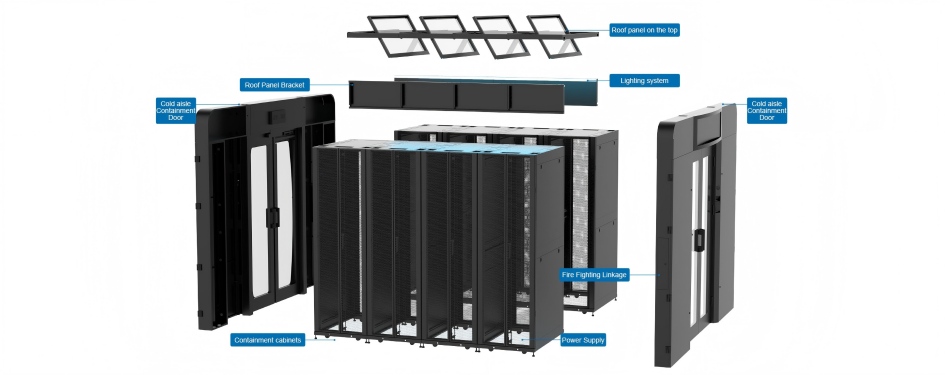
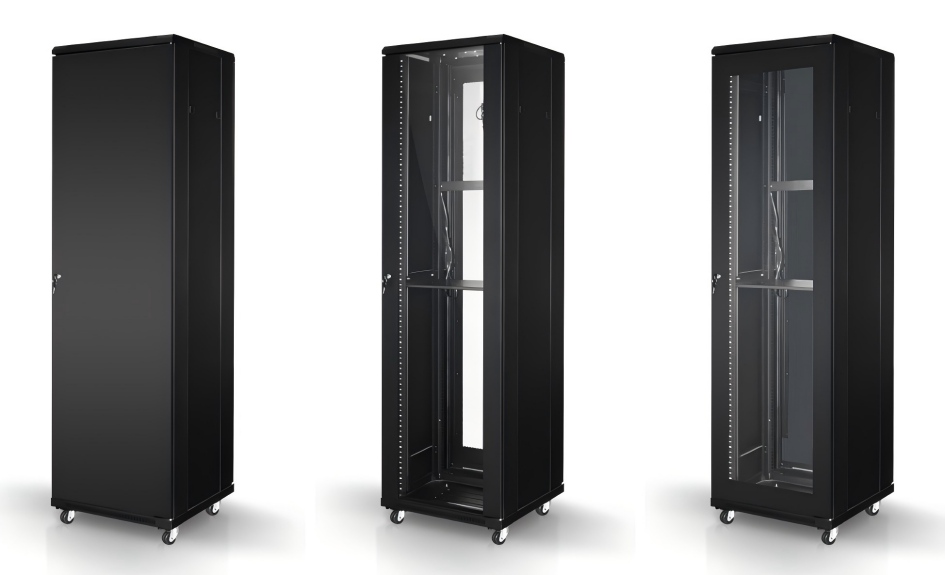
Intelligent Cabinets and Cold Aisle Systems: We provide a full range of products from network cabinets and server racks to wall-mount and open-frame racks, with multiple specification options for each model to meet personalized needs. Paired with advanced cold aisle containment systems, they effectively manage airflow and improve cooling efficiency.
Modular Data Center Solutions: Our modular infrastructure and services support rapid deployment and flexible scaling, ideal for coping with capacity surges and edge computing demands.
Ultra-High-Density Fiber Connectivity Systems: We offer award-winning modular pre-terminated high-density fiber solutions supporting low-loss MPO/MTP connectivity, ensuring superior performance, easy deployment, and seamless scalability to effortlessly meet the fiber density challenges of the 800G/1.6T era.
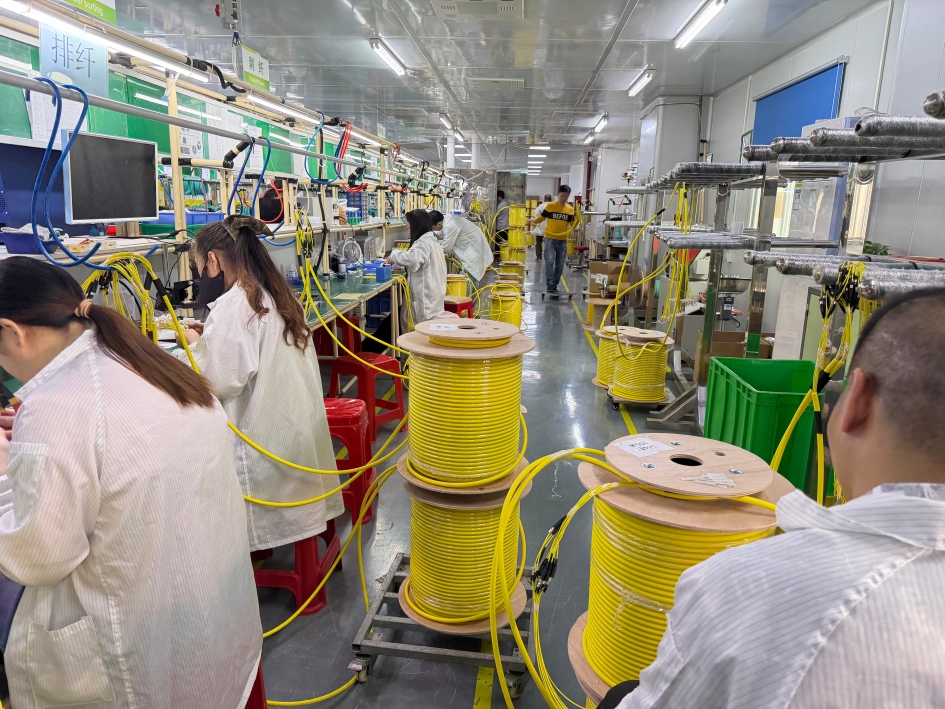
High-Speed Cable Assemblies: From 10G to 800G and beyond, we provide a complete range of DAC, AOC, complex breakout assemblies, and custom fiber solutions for precise connectivity between GPUs, switches, servers, and storage devices.
Comprehensive Infrastructure Support: We build a complete product ecosystem, including advanced fiber testing and inspection equipment to ensure performance reliability, and optimized pathway systems and conduit solutions for efficient fiber management and protection.
Facing the new era of AI-driven data centers, let Kexint be your strategic partner. We provide not just products, but end-to-end capabilities to convert power into insight and complexity into advantage, guiding you steadily toward the future.