A high-tech enterprise specializing in the research and development of optical fiber communications and manufacturing.
Language
A high-tech enterprise specializing in the research and development of optical fiber communications and manufacturing.
Technology Overview
While OSFP1600 supports future switch chips with 200 Gb/s electrical lanes, there is strong market interest in 1.6 Tb/s optical modules based on the existing 100 Gb/s electrical lane ecosystem.
This demand has led to the emergence of the OSFP-XD (eXtra Dense) form factor. By increasing the number of electrical lanes from 8 to 16, OSFP-XD enables 1.6T capacity (16×100 Gb/s) and is also ready for 3.2T capacity (16×200 Gb/s) in the future.
With these capabilities, OSFP-XD supports a wide range of system configurations. In summary, OSFP-XD doubles the front-panel density compared to 8-lane OSFP or QSFP-DD form factors.
1.6T OSFP-XD DR8 Optical Module
The 1.6T OSFP-XD DR8 optical module marks a major breakthrough in high-speed optical communication, supporting an impressive data rate of up to 1.6 Tbps (terabits per second).
Based on the OSFP-XD (Octal Small Form-factor Pluggable – eXtended Density) form factor, this module integrates advanced technologies and is purpose-built to meet the growing bandwidth demands of modern data centers, cloud computing, and AI workloads.
Its DR8 architecture uses 8 parallel channels and delivers powerful performance over single-mode fiber, making it especially well-suited for long-reach interconnect applications.
Importance in Modern Data Centers
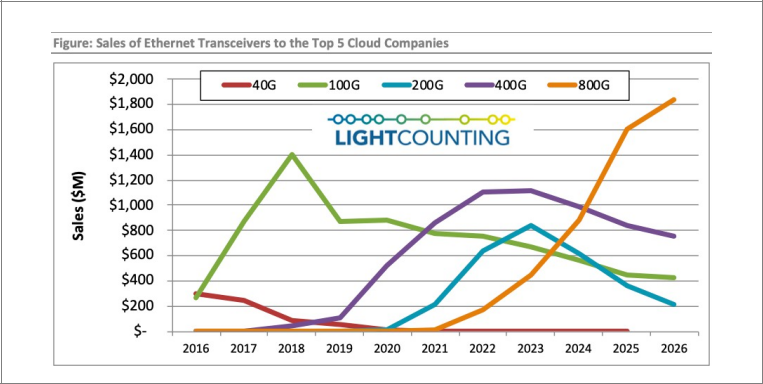
As data centers scale to handle massive data volumes driven by AI, machine learning, and 5G applications, the need for higher bandwidth and lower latency has surged. The 1.6T OSFP-XD DR8 module addresses these needs by providing double the bandwidth of its 800G predecessors while maintaining compatibility with existing infrastructure. Its role in enabling high-density, high-efficiency networking positions it as a cornerstone for next-generation data center architectures.


Key Technical Specifications and Innovations
Ultra-High Bandwidth with PAM4 Modulation
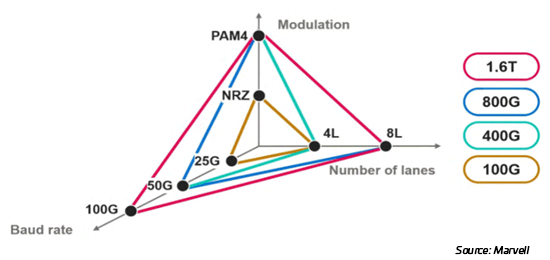
The 1.6T OSFP-XD DR8 optical module achieves a total bandwidth of 1.6 Tbps through 8 parallel channels, each operating at a data rate of up to 212.5 Gb/s. This high-speed transmission is made possible by PAM4 (4-level Pulse Amplitude Modulation) technology, which encodes 2 bits of data per symbol. Compared to traditional NRZ modulation, PAM4 doubles the bandwidth efficiency.
PAM4 technology not only increases data rates and improves spectral efficiency but also reduces the demand for fiber resources. It has become the mainstream modulation format for high-speed optical communication.
At the same time, the module ensures reliable data transmission through signal integrity control at high data rates, meeting the needs of high-throughput and low-latency intra-data center connections.
High-Performance EML Laser with Silicon Photonics Integration
At the core of the module is an EML (Electro-Absorption Modulated Laser), which combines the stability of a DFB laser with the high-speed modulation capabilities of an EAM. This design offers key advantages such as low power consumption, high linearity, and low noise.
In addition, by integrating EML with silicon photonics technology, the module achieves a smaller package size, lower manufacturing cost, and improved power efficiency.
This combination not only supports short-reach data center interconnects up to 500 meters, but also scales to metro network (MAN) and data center interconnect (DCI) applications over distances of 10 to 40 kilometers.
OSFP-XD Form Factor and Hot-Pluggable Design
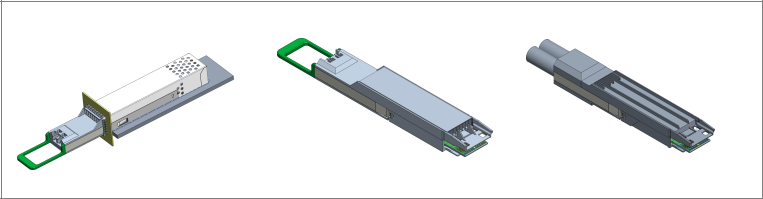
OSFP-XD is a next-generation pluggable form factor designed for ultra-high-density deployments. It offers the following features:
Hot-pluggable capability: Modules can be installed or replaced without interrupting system operation, improving maintenance efficiency and flexibility.
Compact structure with optimized thermal performance: Compared to traditional OSFP modules, OSFP-XD features higher connector density and improved airflow design, enabling stable operation at power levels between 20 and 30W.
High-density port configuration: While maintaining the same physical size as OSFP, OSFP-XD supports higher-density layouts—such as 64 OSFP ports in a 1U chassis—enabling switch capacities up to 51.2 Tbps.
Flexible Configuration and Strong Compatibility
The module is designed with backward compatibility and system scalability in mind. It supports seamless interoperability with existing 800G OSFP modules, simplifying system upgrades. Its ability to coexist and stack with other OSFP or OSFP-XD modules on the same board enables flexible network topologies and configuration combinations.
Additionally, the pluggable architecture retains the key advantages of traditional optical modules—ease of maintenance, configurability, and upgradability—aligning well with current procurement practices in carrier and data center environments.
Power Efficiency and Future Potential
To meet growing bandwidth demands, the module adopts advanced power management strategies. Typical power consumption is maintained within the 20–30W range. Efficient thermal design and airflow guidance help address heat dissipation challenges in high-density deployments. Looking ahead, the evolution path is clear—advancements in DSP technology toward 3nm and 2nm processes are expected to reduce power consumption to 5–6 pJ/bit, further enhancing overall system energy efficiency.
Industry Standards and Compatibility
The 1.6T OSFP-XD DR8 optical module strictly complies with the 1600G Ethernet technical specifications and the OSFP-XD Multi-Source Agreement (MSA) standard.
1600G Ethernet: As the next-generation Ethernet interface standard, it defines an aggregated rate of 1.6 Tb/s and supports ultra-high-speed upgrades for data center backbone networks.
OSFP-XD MSA: A packaging standard jointly developed by leading industry manufacturers to ensure mechanical, electrical, and optical compatibility among modules from different suppliers, reducing procurement and deployment risks for users.
The 1.6T OSFP-XD DR8 optical module integrates core breakthroughs such as PAM4 modulation, high-speed EML lasers, silicon photonic integration, and OSFP-XD high-density packaging. It achieves ultra-high-speed, low-power, and high-density data transmission capabilities. It also offers excellent system compatibility and future scalability. These features make it a key optical interconnect solution for next-generation AI computing and hyperscale data centers.
1.6T OSFP DR8 Specification
| Data Rate | 1×1.6T, 2xDR4 | Form Factor | OSFP |
| Wavelength | 1310nm SMF | Distance | 500m |
| Connector | Dual MPO-12 | Modulation (Electrical) | 8x200G-PAM4 |
| Modulation | PAM4 | Voltage Supply | 3.3V |
| Transmitter Type | 1310nm EML laser | Max Power Consumption | 33.5W |
| Protocols | OSFP1600 MSA | Application | 1.6T-to-1.6T Links |