A high-tech enterprise specializing in the research and development of optical fiber communications and manufacturing.
Language
A high-tech enterprise specializing in the research and development of optical fiber communications and manufacturing.
How Do Fiber Optic Cables Work?
At the heart of every fiber optic cable are thin, flexible glass strands, each about twice the width of a human hair. These strands, protected by individual coatings and bundled together within a sturdy jacket, are the superhighways for our digital data. Inside each strand lies an even smaller "core" of pure glass. This is where the magic happens.
To send data, transmitters at one end translate the 1s and 0s of binary code into flashes of light. These light pulses shoot down the glass core, bouncing along until they reach a receiver at the other end, which instantly translates the flashes back into the data we use. The journey of the light is controlled by the cable's design. For long-haul routes, like connecting cities, singlemode fiber uses a tiny core and a focused laser to keep the light on a straight, efficient path. For shorter runs, like within a building, multimode fiber uses a wider core, allowing the light to scatter and travel in multiple paths, similar to light bouncing off mirrors in a hallway.
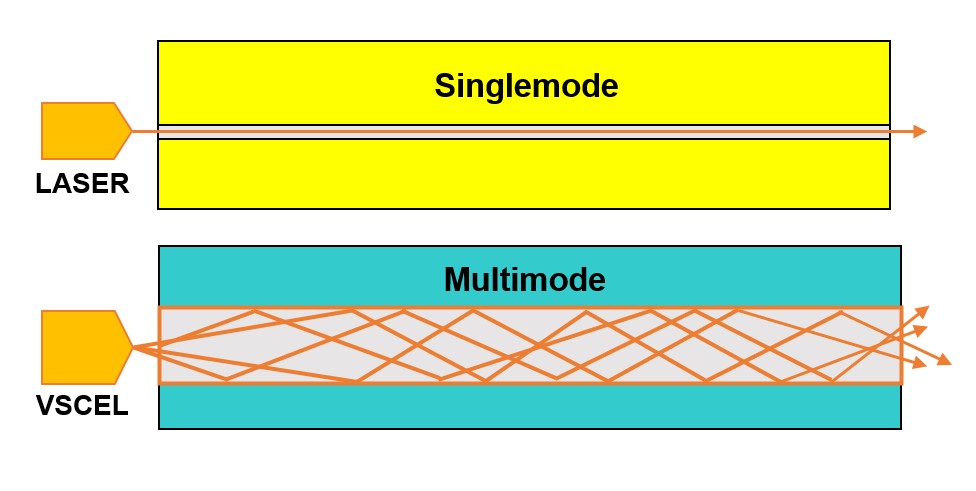
A key consideration with multimode fiber is modal dispersion, where multiple light paths travel at slightly different speeds. This causes light pulses to spread out over time, which inherently limits the effective transmission distance of multimode links. However, because they utilize cost-effective VCSELs rather than expensive high-power lasers, multimode fiber cables remain the preferred and economical choice for short-range applications, such as interconnecting servers and switches within a data center.
Ultimately, understanding the fundamental differences between singlemode and multimode fiber is crucial for selecting the right cabling solution for your specific environment. To support your project, we offer a comprehensive selection of high-quality Fiber Optic Patch Cables designed to meet diverse networking needs.
What Type of Data Does Fiber Optic Cable Transmit?
Think of fiber optic cable as a universal pipe. It doesn't care what flows through it—email text, a streaming video, a backup file, or a remote control command. As long as digital information can be formatted and addressed, fiber can carry it at the speed of light. The only thing it cannot transmit is power, setting it apart from traditional copper wiring.
So, how does the data know where to go? That's the job of communication protocols. In most networks, the protocol of choice is Ethernet. It wraps data into packets, labels them with source and destination addresses, and works with TCP/IP to navigate the internet. But Ethernet isn't the only player. In the world of supercomputing and artificial intelligence, InfiniBand takes over to provide blistering speed. In data storage centers, Fibre Channel handles the heavy lifting.
From the simple act of loading a webpage with HTTP to the complex automation on a factory floor, countless protocols rely on the same foundation: a fiber optic connection ready to carry their data, whatever it may be.
How Much Data Can a Fiber Optic Cable Actually Carry?
If you've ever wondered just how much information can travel through a tiny strand of glass, you're not alone. The answer depends on three key factors: the type of fiber, the application, and the equipment connected at each end.
When discussing fiber capacity, you'll often hear two terms thrown around: bandwidth and data rate. While many people use them interchangeably, they mean different things. Think of bandwidth as the size of a pipe—it's a fixed property of the cable itself. Data rate, on the other hand, is how much water actually flows through that pipe at any given moment.
For multimode fiber, bandwidth is measured as Effective Modal Bandwidth (EMB) , expressed in Megahertz per kilometer (MHz-km). A simple way to understand this is: if a cable has a 500 MHz-km rating, it can transmit a 500 MHz signal over a distance of one kilometer. Want to go farther? You'll need to trade off some frequency. Want to send more data? You'll need higher bandwidth.
Over the years, multimode fiber technology has evolved dramatically. The table below shows just how far we've come—from early generations to today's high-bandwidth cables that power modern data centers and enterprise networks.
| Multimode Fiber Type | EMB at 850nm |
| OM1 | 200 MHz-km |
| OM2 | 500 MHz-km |
| OM3 | 2000 MHz-km |
| OM4 | 4700 MHz-km |
| OM5 | 4700 MHz-km |
Many people wonder: what's the real difference between singlemode and multimode fiber? The most fundamental distinction is that singlemode fiber, by supporting only one path for light propagation, theoretically has no limit on modal bandwidth. Its bandwidth bottleneck primarily comes from the equipment at both ends—with high-end optical modules, singlemode fiber systems can achieve bandwidth in the hundreds of GHz range.
This single-path transmission characteristic gives singlemode fiber another advantage: it can utilize multiple wavelengths more efficiently for simultaneous data transmission. Multimode fiber typically operates at 850nm and 1300nm wavelengths (with OM5 multimode fiber additionally supporting 880nm, 910nm, and 940nm), while singlemode fiber can use a much broader wavelength range, extending from 1270nm all the way to 1610nm.
So, just how fast can a single fiber transmit data? We typically measure this using data rate, expressed in Mb/s or Gb/s. Unlike the bandwidth property of the fiber itself, data rate depends more on the capabilities of the optical modules. Currently, the signaling rate per lane has reached 100Gb/s. But when higher speeds are needed, engineers have two powerful tools at their disposal: parallel optics technology, which enables multiple fibers to work simultaneously, and Wavelength Division Multiplexing (WDM) technology, which allows multiple signals at different wavelengths to travel through the same fiber.
An example makes this clear: An 8-fiber multimode cable, using 4 fibers for transmitting and 4 fibers for receiving, with each fiber running at 100Gb/s, can achieve a total data rate of 400Gb/s. Even more impressive, a duplex singlemode cable using WDM technology can achieve the same 400Gb/s—with 4 wavelengths transmitting simultaneously on one fiber and 4 wavelengths receiving on the other. Current industry standards already support 1.6Tb/s. and even higher speeds are on the horizon.
Finally, let's talk about transmission distance. Because singlemode fiber's bandwidth advantage is so significant, it can maintain the same data rate over dramatically longer distances. Take 10Gb/s for example: multimode fiber can reach about 550 meters, while at 400Gb/s, it's limited to roughly 100 meters. Singlemode fiber, by contrast, can easily transmit these speeds over 40 kilometers or more. This is why long-haul backbone networks must use singlemode fiber, while multimode fiber—with its cost advantages—remains the mainstream choice for short-distance applications like inside data centers.