A high-tech enterprise specializing in the research and development of optical fiber communications and manufacturing.
Language
A high-tech enterprise specializing in the research and development of optical fiber communications and manufacturing.
What is Metro Ethernet?
Metro Ethernet is a metropolitan area network (MAN) technology based on Ethernet standards, designed to interconnect multiple sites across a city or urban region. It provides a scalable and cost-effective solution for linking business locations, data centers, and other facilities within a metropolitan area.
Originally developed for local area networks (LANs), Ethernet once had limited reach and bandwidth. It has since evolved into Carrier Ethernet, which supports high-bandwidth, long-distance transmission suitable for wide area networks (WANs).
Metro Ethernet is a metropolitan application of Carrier Ethernet, typically offering data transfer speeds ranging from 1 Mbps to 10 Gbps to meet diverse enterprise and service provider needs.
What’s Metro Ethernet used for?
If you’re a business or network service provider, you can use Metro Ethernet in a metropolitan area network to:
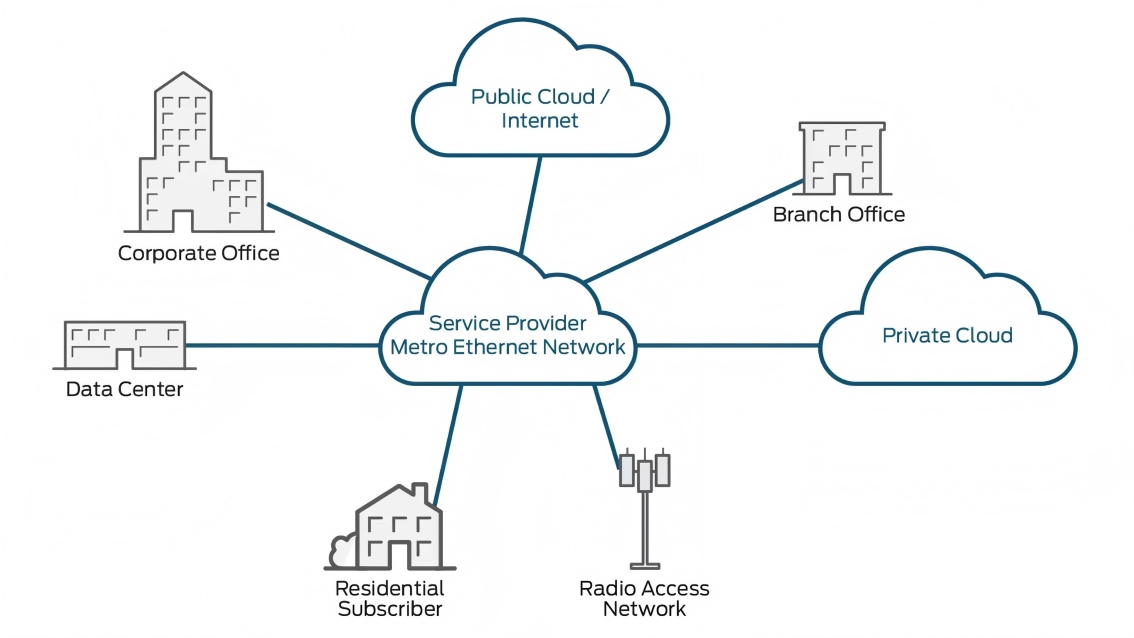
Interconnect your business offices or data centres
Connect your business sites to the internet
Provide IPTV, video conferencing and other collaboration tools via multicasting
Connect your business sites to cloud services
Deliver internet connectivity to business or domestic subscribers if you’re an internet service provider (ISP)
Provide mobile backhaul services if you’re a mobile provider
In other words, you can connect all your sites in a city to the internet and the cloud in a single, scalable network.
Common Metro Network Architectures
Metro networks today are typically built using one of the following approaches:
Pure Ethernet: Low cost but challenges with reliability; suitable for small-scale deployments.
OTN: Efficient when OTN infrastructure already exists; limited flexibility for dynamic bandwidth allocation.
Ethernet over MPLS: Highly reliable and scalable; often used by large service providers but costly.
Ethernet over DWDM: The most flexible and efficient option—maximizing fiber capacity while enabling scalable service growth.
What are the benefits of Metro Ethernet for businesses?
Metro Ethernet provides a compelling suite of benefits designed for modern network demands:
High speed: Metro Ethernet offers high bandwidth, providing fast connectivity with low latency.
Service Flexibility: Delivers versatile support for multiple service types and transport modes.
Operational Reliability: Ensures network integrity with Ethernet OAM for proactive fault detection, reporting, and performance management.
Economic Efficiency: Reduces complexity and simplifies maintenance, leading to lower capital and operational expenditures versus conventional WANs.
Guaranteed Performance: Offers sophisticated QoS controls—such as classification, policing, and scheduling—to prioritize critical applications.
Future-Ready Scalability: Facilitates smooth bandwidth expansion from 1 Mbps to 10 Gbps, allowing flexible, incremental capacity increases with minimal infrastructure changes.
Metro Ethernet connection options
E-LINE: Normally referred to as Point to Point connection, connects point “A” to Point “B”.
E-LAN: Normally referred to as Multipoint to Multipoint connection, each site communicates to another without going through the HQ.
ETREE: Normally referred to as Hub and Spoke, all services have to pass through the HQ before going to final destination.
MPLS Layer 3 VPN: uses a peer-to-peer model through a Border Gateway Protocol (BGP) to distribute VPN-related information. Routing information is outsourced to service providers.
Smart risk management
Metro Ethernet enables intelligent risk management through logical partitioning. Multiple network functions operate independently within a single chassis, isolated operationally, functionally, and administratively. By partitioning a physical system (e.g., a Broadband Network Gateway) into separate logical instances, failures are contained. These partitions share only physical resources (chassis, space, power), not control or data planes, preventing localized issues from causing widespread outages.
How does Metro Ethernet work?
Metro Ethernet creates metropolitan-scale connectivity by linking switches and routers over fiber optics, supporting both point-to-point and point-to-multipoint services.
Network Architecture:
Core Network: Uses high-speed backbone routing, commonly based on Multi-Protocol Label Switching (MPLS), to ensure rapid and reliable data transport across the metro area.
Aggregation/Distribution Network: Connects the core to local areas, often leveraging access technologies such as Passive Optical Networks (PON), DSL, or microwave wireless links.
Access Layer: Comprises customer-premises equipment (e.g., optical network terminals or business routers), serving as the final link to end-user devices.
The physical topology of the network is designed flexibly to match the specific service model being deployed.