A high-tech enterprise specializing in the research and development of optical fiber communications and manufacturing.
Language
A high-tech enterprise specializing in the research and development of optical fiber communications and manufacturing.
Types of MTP/MPO Cables
MTP/MPO cables for switch-to-switch connections are typically plenum-rated for indoor use and available in both singlemode (OS2) and multimode fiber types (OM3, OM4, OM5). OM4 is the most common choice for multimode applications due to its minimized differential mode delay, which supports longer distances. OM5 fiber is optimized for short wavelength division multiplexing (SWDM), allowing multiple wavelengths to transmit data simultaneously for extended reach.
These cables come in standard or custom lengths and range from 8 to 144 fibers, terminated with 8-, 12-, 16-, or 24-fiber MTP/MPO connectors. Higher-fiber-count cables feature multiple connectors under a single sheath—for example, a 72-fiber cable typically has six 12-fiber connectors on each end. Newer very-small form factor (VSFF) connectors, such as US Conec’s MMC 16-fiber connector, offer three times the port density due to their compact size.
MTP/MPO cables can be configured as trunk cables with identical connectors on both ends or as breakout (fan-out) cables for connecting high-speed ports to multiple lower-speed devices. While breakout cables often transition from MTP/MPO to duplex connectors for 25, 50, or 100 Gig servers, they can also support switch-to-switch links—for instance, breaking a 16- or 24-fiber connector into multiple 8- or 12-fiber MTP/MPO connectors to optimize port utilization.
How to Choose the Right MTP/MPO Cable
The choice of MTP/MPO cables for switch-to-switch connections is primarily driven by the specific application requirements, which are influenced by factors such as transmission speed, distance between switches, cost, and port density.
Both multimode and singlemode fiber cables support 200, 400, and 800 Gig speeds, but the reach varies significantly. Multimode fiber is typically limited to 100 meters for high-speed links, making it suitable for most intra–data center connections. Singlemode fiber supports distances up to 40 kilometers, which is essential for larger cloud or hyperscale data centers where links may exceed 100 meters. Cost also plays a key role; longer-reach singlemode applications often require WDM optics that can cost up to five times more than multimode equipment. For distances beyond 100 meters, short-reach DR singlemode applications offer a cost-effective alternative using power-efficient lasers, while short-reach VR multimode applications remain the most economical choice for links under 50 meters.
Fiber count and connector type vary by application. For instance, 200 and 400 Gig SR4, VR4, and DR4 links use 8-fiber MTP/MPO connectors with four transmitting and four receiving fibers at 50 or 100 Gb/s per lane. In contrast, 800 Gig SR8, VR8, and DR8 applications require 16 fibers—eight transmitting and eight receiving at 100 Gb/s per lane—which can be supported by dual 8-fiber connectors, a single 16-fiber MTP/MPO connector, or a 16-fiber VSFF MMC connector. The connector interface must also match the switch port or patch panel, with VSFF connectors like the MMC offering higher density for space-constrained environments. The table below summarizes the latest multimode and singlemode applications for 200, 400, and 800 Gig switch-to-switch links using MTP/MPO cables.
| MULTIMODE APPLICATIONS | |||
| Application | Distance (Meters) | # of Fibers | Connector |
| 200GBASE-SR4 | 70 m (OM3) 100 m (OM4/OM5) | 8 | MPO-8 |
| 400GBASE-SR4.2 | 70 m (OM3) 100 m (OM4) 150 m (OM5) | 8 | MPO-8 |
| 400GBASE-SR8 | 70 m (OM3) 100 m (OM4/OM5) | 16 | MPO-16, MMC |
| 400GBASE-VR4 | 30 m (OM3) 50 m (OM4/OM5) | 8 | MPO-8 |
| 800GBASE-SR8 | 60 m (OM3) 100 m (OM4/OM5) | 16 | MPO-16, MMC |
| SINGLEMODE APPLICATIONS | |||
| Application | Distance (Meters) | # of Fibers | Connector |
| 200GBASE-DR4 | 500 m | 8 | MPO-8 |
| 400GBASE-DR4 | 500 m | 8 | MPO-8 |
| 800GBASE-DR4 | 500 m | 16 | MPO-16, MMC |
Other Key Considerations
Additional considerations for selecting MTP/MPO cables include breakout configurations and connector endface types. Breakout applications, such as 2X100G, 4X100G, 2X200G, or 2X400G, require specific cable designs. For instance, a 4X100G breakout cable typically features an 8-fiber MTP/MPO connector on one end and four duplex connectors on the other. In HPC environments like AI clusters, 2X400G breakout applications are common, using a 16-fiber MTP/MPO connector that breaks out into two 8-fiber MTP/MPO connectors.
Connector endface type is another critical factor. UPC (flat) connectors are standard for multimode applications, while APC (angled) connectors are required for singlemode due to their lower reflectance, which is essential for minimizing signal loss. APC endfaces are also increasingly recommended for high-speed multimode links at 400G and 800G. It is vital to match the endface type—UPC or APC—with the mating component, as mixing the two can cause signal degradation and potential damage to the connectors.
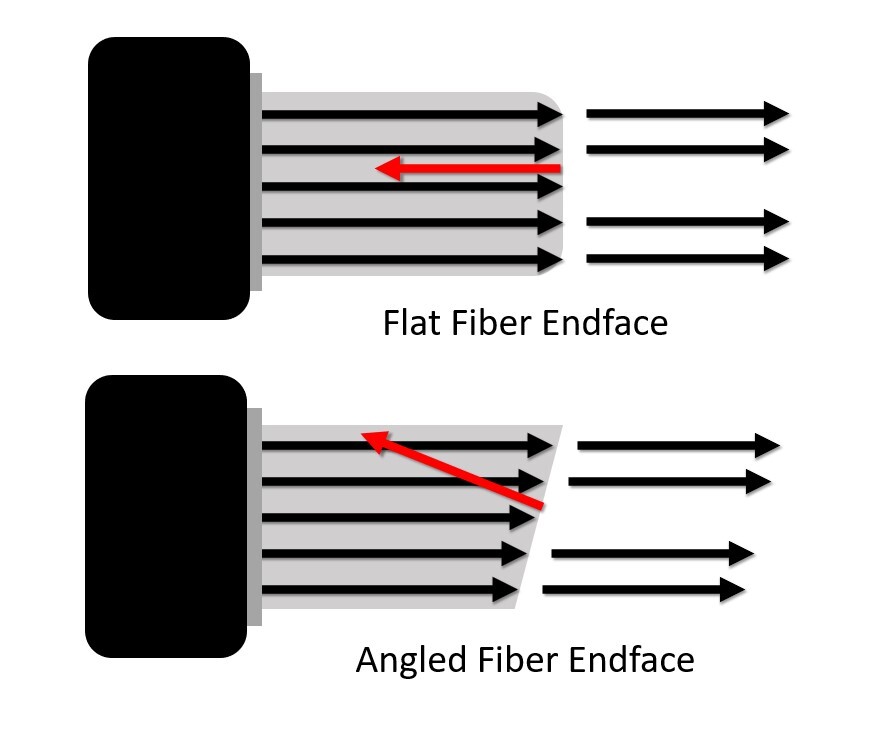
Given that switch-to-switch links form the backbone of data center operations, performance and quality are paramount. To maximize uptime and reliability, choose only MTP/MPO cables constructed with high-quality fiber, precision optical components, and proven insertion loss performance.
KEXINT is a leading supplier of multimode and singlemode MTP/MPO cables, offering custom lengths and configurations tailored to your data center switch-to-switch connections. Every cable is built with state-of-the-art precision components and backed by our unwavering commitment to quality. Contact us today for all your MTP/MPO cabling needs.