A high-tech enterprise specializing in the research and development of optical fiber communications and manufacturing.
Language
A high-tech enterprise specializing in the research and development of optical fiber communications and manufacturing.
The evolution of Category cabling and the future of tomorrow’s network
First introduced by CommScope, as SYSTIMAX® GigaSPEED® X10D, in 2004 and standardized in 2009, Category 6A remains the recommended infrastructure for modern new builds.
In 2004, the industry recognized the bandwidth limitations of Category 5 and Category 6 cabling categories would severely constrain network growth and development. A major challenge was supporting higher data rates over longer distances, compared to Category 6.
Led by the IEEE 802.3an 10GBASE-T Task Force, the search for a 10 GE-capable solution was on. They began by tackling fundamental issues like return loss, crosstalk, and noise from adjacent cabling channels (alien crosstalk). Their work resulted in minimum cabling channel specifications for 10GBASE-T and a new class of cabling, Class EA, otherwise known as “Augmented” Category 6. In October 2004 Cat 6A was officially born.
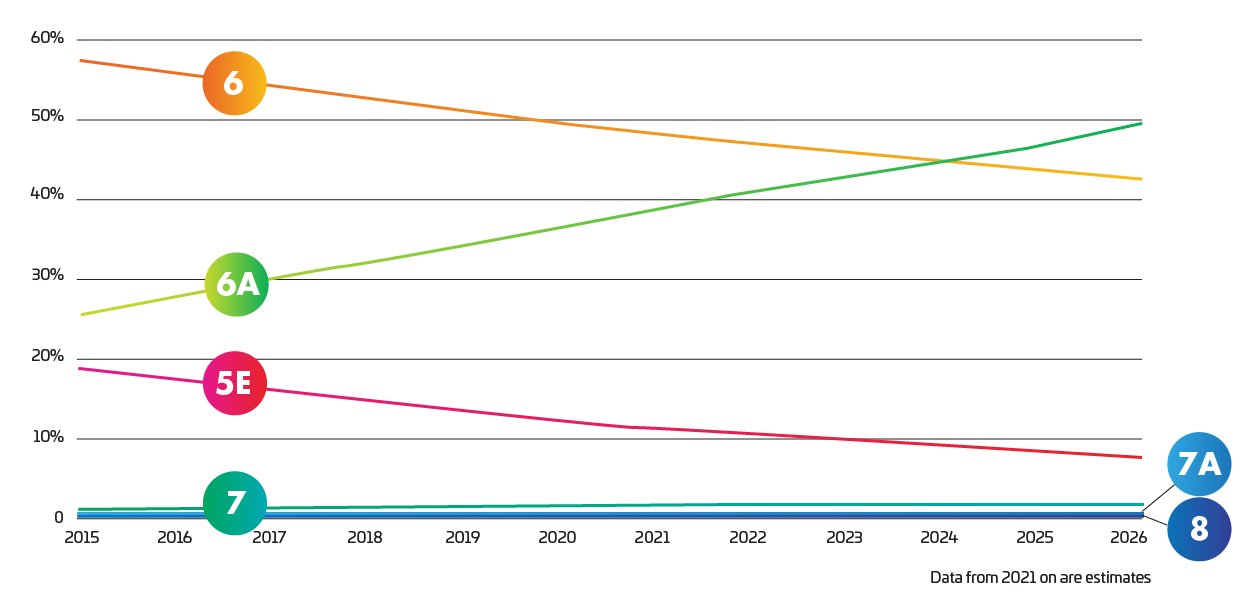
As new applications require better cable performance, adoption rates of Cat 6A have steadily increased. Drivers such as IoT, Wi-Fi 6/6E/7, four-pair PoE, smart lighting, building control/automation, in-building cellular, and more, will extend the uptake of Category 6A for the foreseeable future.
Based on the graph, looks like the smart money is on Category 6A.
CAT 6A: Hard facts
Network speed vs span: How fast depends on how far
Much of the network’s design depends on where the data is generated and where it must be processed and stored. More network resources are moving to the edge while data speeds and capacity demands keep increasing beyond the capabilities of existing Category 5 and Category 6 networks.

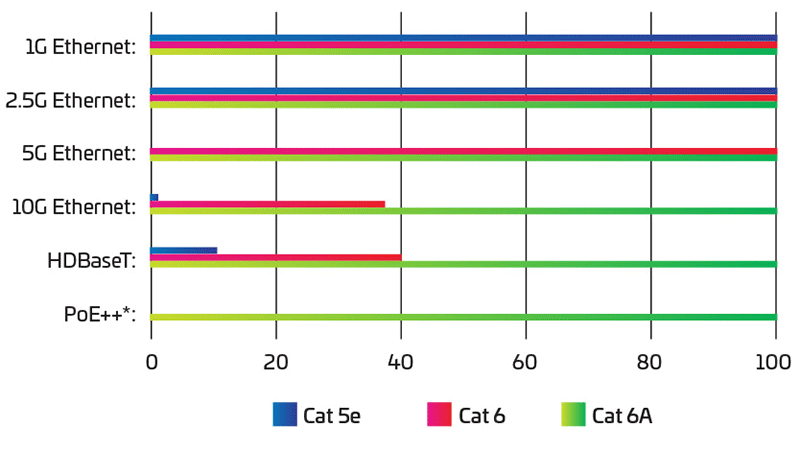
Specifically, Category 5/6 are susceptible to channel impairments created inside the operating environment. Crosstalk, impedance mismatch, external noise, return loss, and other issues cause bit errors that can reduce overall throughput. Category 6A cabling is specifically engineered to overcome these challenges, enabling networks to support 10 GE channels up to 100 meters—nearly three times longer than Category 6.
Not just any Cat 6A. CommScope’s family of Category 6A solutions provides enhanced cable and connector performance, so you can support the latest 10 GbE requirements.
| Category | Bandwidth | Distance for 1G | Distance for 10G |
| Cat 5e | 100 MHz | 100m | --- |
| Cat 6 | 250 MHz | 100m | 37m |
| Cat 6A | 500 MHz | 100m | 100m |
| Cat 7 | 600 MHz | 100m | 100m |
| Cat 7A | 1000 MHz | 100m | 100m |
| Cat 8 | 2000 MHz | 100m | 100m |
Meeting PoE power standards for connected devices
Full-on network convergence in the enterprise space is underway. Device OEMs are taking advantage of updated PoE standards that enable all four cable pairs to double the power delivery compared to PoE applications using just two pairs. For applications requiring more than 25.5 watts, the only standards-recommended cabling solution is, you guessed it, Cat 6A.
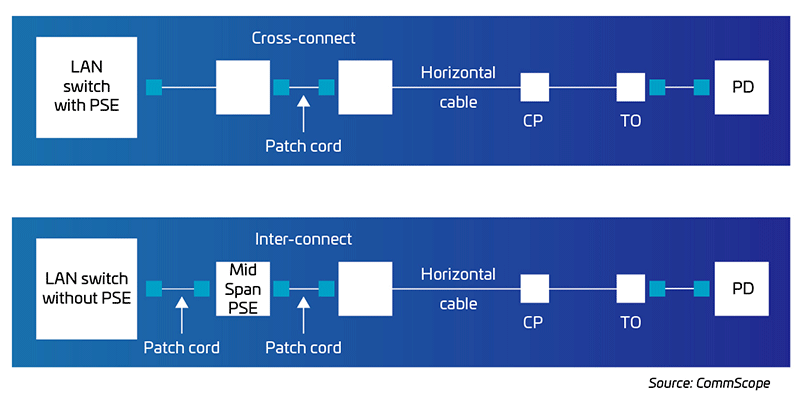
Power from LAN equipment with end-span PSE (top) and a mid-span (bottom)