A high-tech enterprise specializing in the research and development of optical fiber communications and manufacturing.
Language
A high-tech enterprise specializing in the research and development of optical fiber communications and manufacturing.
What is an MPO connector?
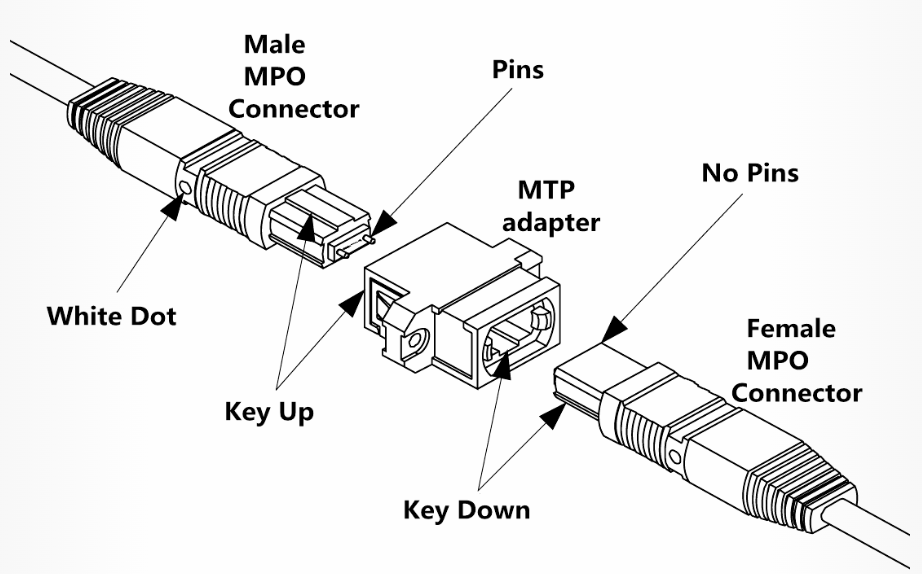
The MPO (Multi-fiber Push-On) connector is a high-density multi-fiber connector standard developed by NTT of Japan and later standardized by IEC-61754-7 and TIA-604-5. The MPO connector, also known as a multi-fiber push-on connector, is a fiber optic connector consisting of multiple optical fibers. In data centers, you will find MPO connectors equipped with 8, 12, or 24 fibers. In addition, connectors with a larger number of fibers are also available, which are usually used in ultra-high-density applications. The MPO cable assembly contains optical fibers, jackets, dust caps, and connector coupling components, which include metal springs, guide pins, and ferrules. MPO connectors are available in male and female versions. The male connector has two pins, while the female connector has no pins. The MPO connector has a key on one side of the connector body that is used to determine the fiber position and ensure that the connector can only be inserted into the MPO adapter or transceiver port in one way. The key of the MPO connector with 8, 12, and 24 fibers is located in the center of the housing.
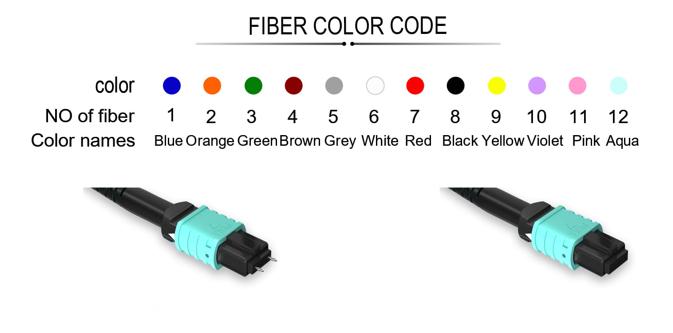
MPO fiber starting position
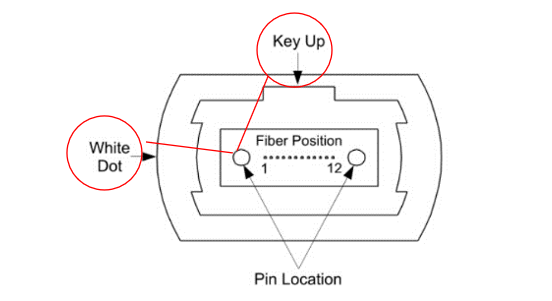
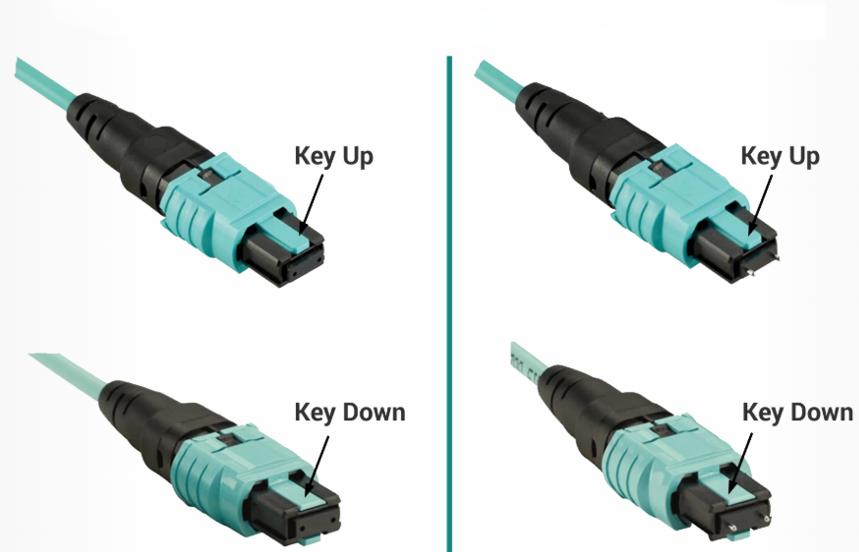
MPO connectors can accommodate 8 to 72 fibers, with 12-fiber arrays being the most common configuration for enterprise data center applications such as 40 Gb and 100 Gb. Each connector is either male (with ferrules) or female (without ferrules) to ensure that the fiber end faces remain aligned during the mating process. MPO connectors also include a key on the top of the connector and a white dot on the side to indicate the location of position 1. As shown in the figure above, the orientation of the key is also critical when it comes to polarity.
What does OM mean in MPO fiber?
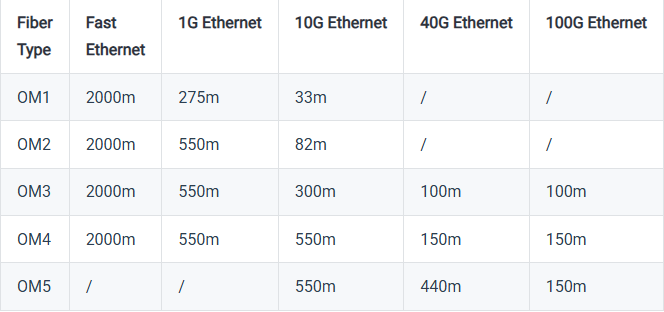
OM1, OM2, OM3, OM4, and OM5 are iterative names of multimode fiber types. "OM" is the abbreviation of "Optical Multimode". The Arabic numerals can be understood as the release order of different generations of multimode fiber standards. Arranged in chronological order, the larger the number, the later the release time. OM1 fiber is the earliest, and OM5 fiber is the latest version. Different types of OM have different core diameters and meet different transmission rates. For example, if you want to meet the parameter rate of 100G rate, you need to choose at least OM4 MPO fiber jumper.
Two MPO Fiber Polarity
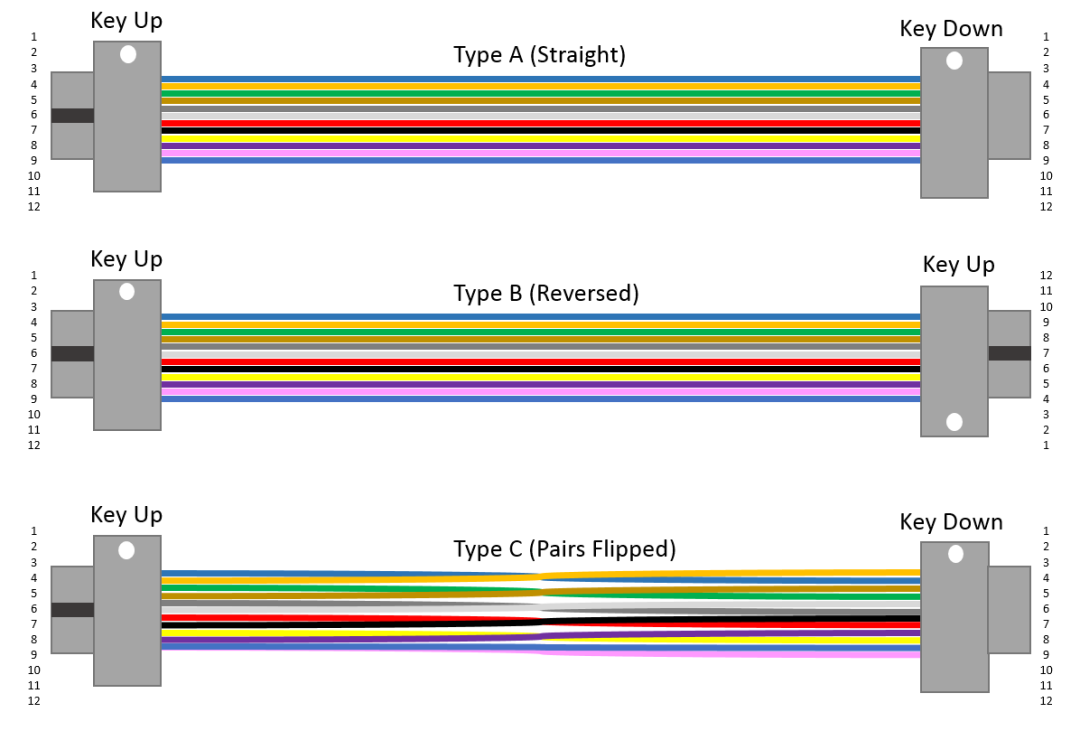
MPO cables also come in three different types – Type A, Type B, and Type C.
Type A is a straight-through MPO trunk cable with a Key Up connector on one end and a Key Down connector on the other end, which allows the fiber in position 1 to go to position 1 on the other end. Type B cables are Key Up to Key Up, so the fiber in position 1 goes to position 12 on the other end, the fiber in position 2 goes to position 11 on the other end, and so on. Type C cables flip the pairs so that the fiber in position 1 goes to position 2 on the other end, and the fiber in position 2 goes to position 1.
How to connect two MPO fibers?
To make an MPO connection between two MPO fibers, an MPO adapter must be used, and the connector types should be opposite. This means that only male-to-female connections can be achieved, not male-to-male or female-to-female connections. If female connectors are used on both ends of the adapter, the performance will be very low because the fibers cannot be aligned without male pins. On the other hand, using two male connectors is impossible and may damage the connectors.