A high-tech enterprise specializing in the research and development of optical fiber communications and manufacturing.
Language
A high-tech enterprise specializing in the research and development of optical fiber communications and manufacturing.
What is LC in Fiber Opticals?
The abbreviation "LC" in fiber optics refers to the Lucent Connector, a nomenclature tracing back to its developer, Lucent Technologies (now part of Nokia). This connector features a renowned 1.25mm ceramic ferrule and an intuitive RJ-45-style latch mechanism for secure engagement. Its defining characteristic is a physical footprint that is 50% smaller than the legacy SC connector, a design breakthrough that directly catalyzed the trend toward high-density networking in data centers and enterprise LANs, all while maintaining superior alignment and compliance with industry standards.
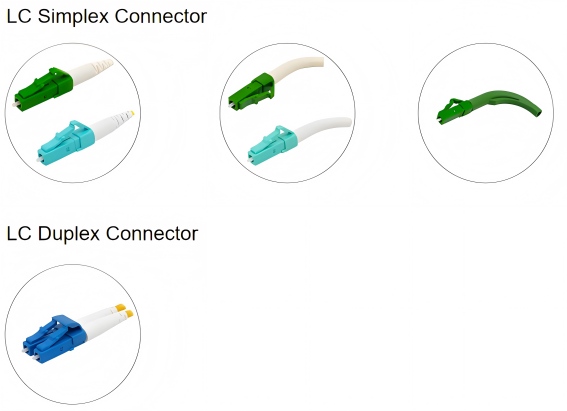
What are the defining features that secure the LC connector's leading position in a competitive market?
Its sustained dominance is built upon several key advantages that cater to diverse application needs:
Space-Efficiency: With a footprint 50% smaller than standard SC/FC/ST connectors, the LC's miniature design is the ultimate solution for high-density cabling, allowing more connections in the same rack space.
Reliable Low Loss: The connector's refined ferrule design and six-position tuning capability ensure exceptional core alignment. This translates to reliably low insertion loss, guaranteeing signal integrity for critical links.
Adaptable Assembly Options: The LC ecosystem offers unmatched versatility. For quick deployments, pre-assembled one-piece connectors save valuable time. For customized solutions, multi-piece kits provide the flexibility needed for efficient factory termination, catering to varied installer preferences.
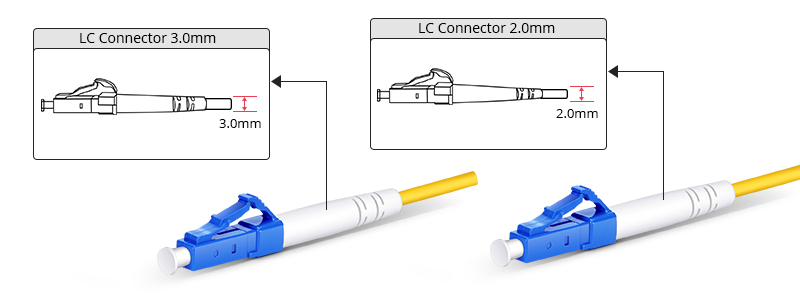
LC BTW Connectors
The LC BTW connector is a compact variant of the standard LC, specifically engineered for 0.9mm buffered fiber. Its reduced overall length makes it particularly suited for high-density applications on the equipment side, such as within chassis or at board interfaces. A notable version is the LC BTW unibody connector, which leverages a one-piece design to enhance assembly consistency and reliability in constrained spaces.
LC Fiber Patch Cable Solution
Standard LC Fiber Patch Cable
In today's high-density networks, the LC-LC fiber patch cable has become the ubiquitous solution for linking active equipment. Its dominance is attributed to the LC connector's miniature design, which allows for superior port density on faceplates and transceivers compared to conventional SC cables, without compromising on stable, low-loss performance. This makes it the preferred choice for installations ranging from data center racks to enterprise telecom rooms. These cables are comprehensively available in all common formats, including single-mode (OS1/OS2), multimode (OM1/OM2/OM3/OM4/OM5), and in both simplex and duplex types.
Uniboot LC Fiber Patch Cable
The relentless push for higher density in data centers necessitated a breakthrough in cable design, leading to the creation of the uniboot LC fiber cable. As the comparative image illustrates, the uniboot LC (right) features a revolutionary single-boot design that houses two fibers, presenting a stark contrast to the bulkier form of the standard duplex LC cable (left). This innovative approach minimizes the cable footprint, enabling superior rack space utilization and streamlined pathways.
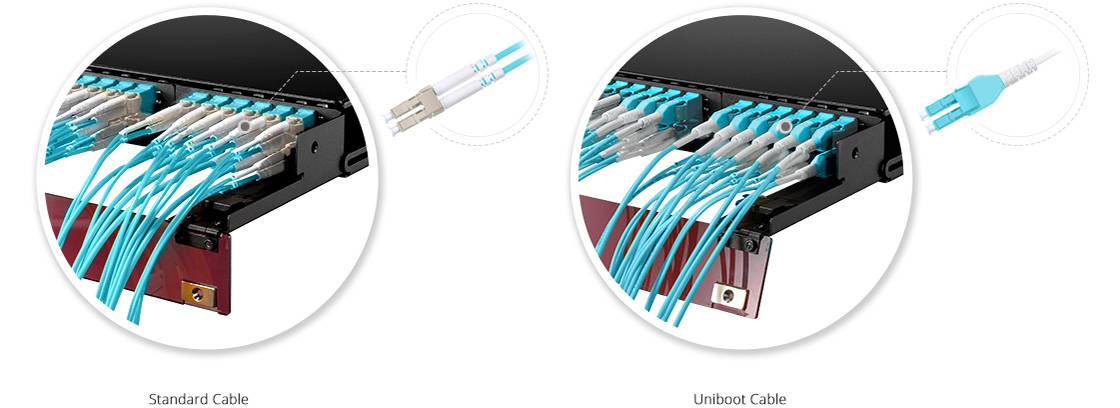
Engineered for maximum efficiency, the Uniboot LC patch cord features a revolutionary design: two fibers housed in one cable, with both connectors sharing a common, slim-line boot. This immediately halves the cable bulk versus standard duplex LC cords. When equipped with a push-pull tab, this solution unlocks a further 50% gain in faceplate density, allowing data center operators to achieve unprecedented port utilization within the same rack space.
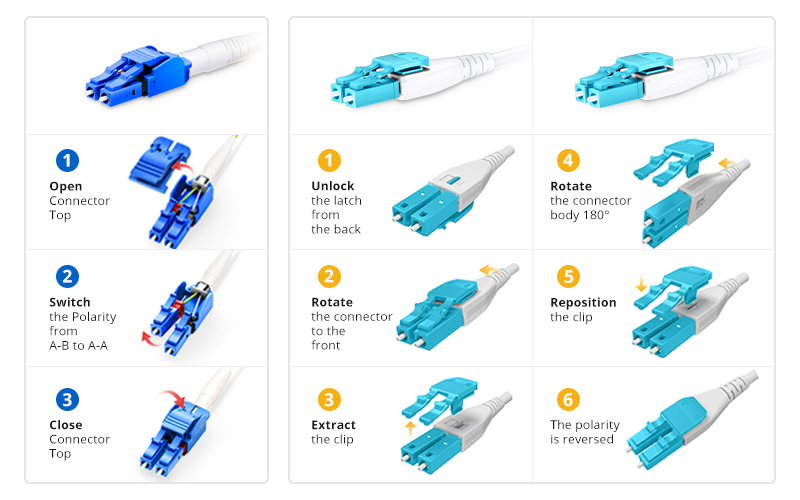
LC Unibody Fiber Patch Cable
The core of the LC Unibody fiber patch cable lies in its innovative LC Unibody connector. This connector features a one-piece integrated design that combines the separate components of a traditional LC connector—such as the boot, strain relief, and connector body—into a single, robust unit. This structural design fundamentally eliminates the potential issues of loosening, twisting, or separation that can occur in traditional multi-part connectors during long-term plugging and unplugging or under sharp bending, thereby providing unparalleled mechanical stability and reliability.
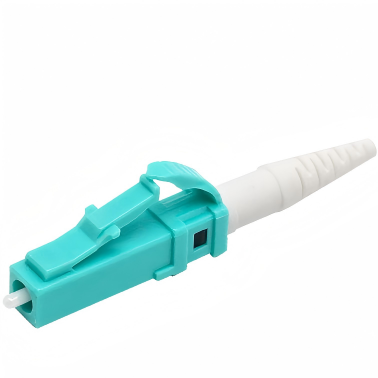
In terms of performance, the Unibody design offers superior protection and support for the internal precision ceramic ferrule, ensuring the fiber cores maintain optimal alignment. This results in lower and more stable insertion loss. Furthermore, the installation process is significantly simplified, reducing the number of components and procedural steps required for field assembly. This greatly enhances installation efficiency and lowers the risk of performance degradation due to improper handling. Consequently, patch cables utilizing the LC Unibody connector are not only an ideal solution for high-density data centers pursuing ultimate stability and convenience but also the preferred choice for ensuring absolute link reliability in harsh industrial environments.
Conclusion
LC Unibody, LC Uniboot, and LC Uniboot Push-Pull connectors collectively represent the key evolution of LC interface technology in pursuit of higher density and optimized operational efficiency. The market benefits they deliver are clear and direct: The LC Unibody connector significantly enhances connection reliability and installation efficiency through its integrated design, reducing long-term maintenance costs. The LC Uniboot connector, by integrating two fibers into a single cable, fundamentally reduces the space occupation in high-density cabling environments by up to 50%, directly freeing up valuable rack space. Building on this, the LC Uniboot Push-Pull connector goes a step further; its unique push-pull tab design allows for effortless blind mating on extremely congested port panels, pushing port density and operational efficiency to new limits. Together, these three technologies offer data center and enterprise network investors a compelling value proposition: achieving dual optimization of spatial costs and operational expenses without compromising performance or reliability, ultimately significantly enhancing the total value and return on investment of network infrastructure.