A high-tech enterprise specializing in the research and development of optical fiber communications and manufacturing.
Language
A high-tech enterprise specializing in the research and development of optical fiber communications and manufacturing.
Clarify the purpose of optical cables
Indoor optical cables can be divided into the following types according to their structure, performance and application scenarios:
1. Indoor trunk optical cables are used to provide communication channels between the inside and outside of buildings and connect the wiring rooms on each floor.
It has a large number of cores, a strong structure, good tensile resistance and compression resistance.
2. Indoor wiring optical cables connect the wiring rooms on each floor with the work area to provide network connections for terminal equipment.
It has a small number of cores and a compact structure, which is suitable for small spaces, and has good flexibility and bending resistance.
3. Indoor relay optical cables are used to extend the communication distance and can connect two sections of optical cables.
It has stable performance and low loss, which can ensure long-distance transmission of signals.
4. Vertical optical cables are used in pipes in vertical shafts between floors.
Select vertical lifting optical cables that can withstand large deadweight and tensile force to ensure stable operation of the optical cables.
5. For special optical cables in places with rodent damage, rat-proof optical cables are preferred to protect the optical cables from damage.
Select the fiber type
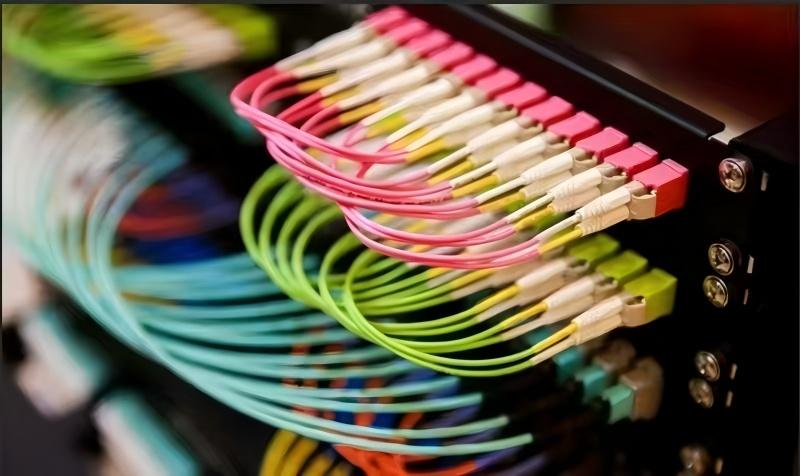
Single-mode fiber: suitable for long-distance transmission, suitable for enterprise computer rooms, data center network layout.
Multimode fiber: suitable for short-distance transmission scenarios, meeting the needs of home networks and small network scenarios.
Understanding the transmission rate
The transmission rates of commonly used optical cables are shown in the following table
| Type | Model | Typical rate | Application Scenario |
| Single Mode | OS1 | 10Gbps | Cross-floor backbone network |
| OS2 | 100Gbps | Long-distance scenarios such as subways and computer rooms | |
| Multimode | OM2 | 1Gbps | Small office network |
| OM3 | 10Gbps | Enterprise LAN | |
| OM4 | 40Gbps | Data center, cloud computing | |
| OM5 | 100Gbps | Large Data Center |
Single-mode optical fiber: supports transmission rates of 10Gbps to 100Gbps and above, and supports long-distance transmission. Applicable scenarios: large computer rooms, cross-floor backbone networks, etc.
Multimode optical fiber: commonly used OM3/OM4 or higher, supports 40Gbps/100Gbps (specific equipment required), has strong anti-interference ability, and is suitable for high-density wiring scenarios.
Select sheath material
1. PVC sheath: suitable for conventional indoor wiring, cost-effective, stable and durable.
2. LSZH low-smoke halogen-free sheath: low-smoke halogen-free flame retardant, can be used in safe computer rooms, schools and other scenarios.
Generally speaking, the outer skin of the product will have clear specification markings, marked with information such as fiber type and outer skin material specifications.
Determine the number of fiber cores
Determine the number of fiber cores according to actual needs. For home use, 2 or 4 cores can be selected, and enterprise-level applications usually require more than 8 cores. The more cores, the greater the transmission capacity of the optical cable, but the higher the cost. A 30% margin should be reserved for the actual number of cores used to avoid difficulties in later expansion.